
Can doctors advertise in India?
Yes, within limits. The limits are narrower than most agencies will admit and wider than most doctors fear. Here is what the operative rules actually say, which widely quoted rules are not in force at all, and what a clinic can do this month without putting its registration at risk.
Can doctors advertise in India: the short answer
A doctor cannot solicit patients or promote themselves. A doctor can inform. Facts about your practice, your services and your fees are allowed. Claims about how good you are, are not.
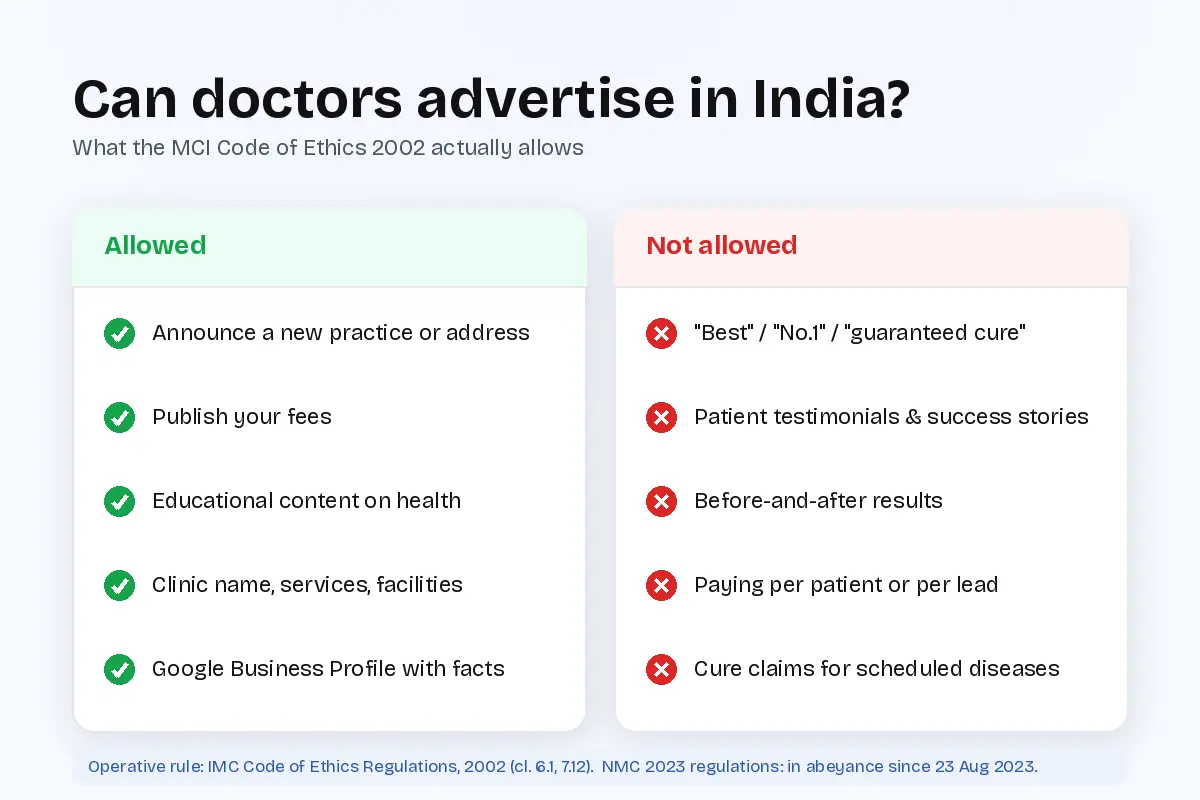
The rule that applies to every registered allopathic doctor in India is the Indian Medical Council (Professional Conduct, Etiquette and Ethics) Regulations, 2002, usually called the MCI Code of Ethics. It is enforced by the National Medical Commission’s Ethics and Medical Registration Board and, in practice, by your state medical council.
Regulation 6.1.1 says that soliciting patients directly or indirectly is unethical. The same regulation then lists seven formal announcements a doctor may make, and Regulation 7.12 lets an institution run by a physician advertise its name, the patients it admits, its facilities and its fees. That is the entire framework. Everything else in this guide is working out where a given post, ad or hoarding falls.
One caution before the detail. This is general information written by a marketing agency, not legal advice. Your state medical council has the final say on a complaint, and if a specific campaign sits anywhere near a line described below, put it past a lawyer first.
Which rules actually apply in 2026
Half the confusion online comes from articles written in August 2023 that were never updated. Here is the current status of every rule you will see quoted.
| Rule | Status in 2026 | Who it binds |
|---|---|---|
| Indian Medical Council (Professional Conduct, Etiquette and Ethics) Regulations, 2002 | In forceRe-adopted by the NMC on 23 Aug 2023 | Every registered medical practitioner in modern medicine |
| NMC Registered Medical Practitioner (Professional Conduct) Regulations, 2023 | Not in forceNotified 2 Aug 2023, kept in abeyance by gazette notification on 23 Aug 2023 | Nobody, yet. Useful as a signal of where the rules are heading |
| Revised Dentists (Code of Ethics) Regulations, 2014 | In force | Registered dentists, via the Dental Council of India |
| Telemedicine Practice Guidelines, 2020 | In forceAppendix 5 of the 2002 regulations | Any doctor consulting online, including in DMs and comments |
| Drugs and Magic Remedies (Objectionable Advertisements) Act, 1954 | In forceCriminal statute | Anyone who advertises, doctor or not |
| Consumer Protection Act, 2019 and the CCPA Guidelines on Misleading Advertisements, 2022 | In force | Anyone who advertises or endorses, hospitals included |
| ASCI Code | Self-regulatoryNot law, but platforms and media act on its rulings | Advertisers, agencies and publishers |
A complaint under the 2002 regulations goes to your state medical council, which can warn you or remove your name from the register, temporarily or permanently.
What happened in August 2023
On 2 August 2023 the NMC notified a new professional conduct code. It included, for the first time, a set of social media guidelines for doctors: no soliciting through social media, no requesting or sharing patient testimonials, no buying likes or followers, no images of cured patients. It also made generic prescribing mandatory, and that is the part the profession revolted against.
Three weeks later, on 23 August 2023, the NMC issued a gazette notification putting the entire 2023 code in abeyance until further notice and re-adopting the 2002 regulations with immediate effect. As of this writing, no further notification has brought the 2023 code back.
So when a page tells you the “NMC 2023 social media rules” ban something, check its date. Those rules describe the direction of travel, and we come back to them in section nine. They are not the law you are held to today.
What the 2002 Code prohibits
Four clauses do almost all the work. Read them once and most marketing questions answer themselves.
Regulation 6.1.1: soliciting patients
“Soliciting of patients directly or indirectly, by a physician, by a group of physicians or by institutions or organisations is unethical.” The clause goes on to bar a doctor from being the subject of any advertisement or publicity that draws attention to their professional position, skill, qualifications, achievements, specialities, appointments, associations or honours in a way that would result in self-aggrandisement.
The same clause forbids two more things that matter for marketing. A doctor may not boast of cases, operations, cures or remedies, or permit reports of them to be published in any medium. And a doctor may not lend their name, signature or photograph to endorse any drug, device, remedy or commercial product.
That single clause is why testimonials, before-and-after images, success-rate statistics, “best in Navi Mumbai” and paid product collaborations are all off the table for an individual doctor.
Regulation 6.1.2: photographs and signboards
Printing your own photograph or other publicity material on your letterhead or on the signboard of your clinic is treated as self-advertisement. Sketches, diagrams and pictures of the human body are fine. This is the most visibly unenforced clause in the Code, and it is still on the books.
Regulation 6.4: rebates and commission
A doctor may not give, solicit or receive any gift, commission or bonus in return for referring, recommending or procuring a patient. In marketing terms, paying per patient or per lead is fee-splitting. An aggregator, listing site or agency that charges you for each booked appointment is putting you in breach, whatever their contract calls it.
Regulation 7.11: writing in the lay press
A doctor should not contribute articles to the general press that advertise themselves. The same clause then says a doctor may write under their own name on matters of public health and hygienic living, and may deliver public lectures. Hold on to that sentence. It is the clause that makes educational content legitimate, and section four leans on it.
What is explicitly allowed
The Code is not only a list of prohibitions. It says, in writing, what you may put in front of the public.
The seven formal announcements (Regulation 6.1.1)
A doctor may make a formal announcement in the press about any of the following:
- Starting practice
- Change of type of practice
- Changing address
- Temporary absence from duty
- Resumption of another practice
- Succeeding to another practice
- Public declaration of charges
The last one is the most underused. You are allowed to publish your fees. Most clinics hide them, then wonder why enquiries go quiet the moment price comes up on WhatsApp.
Institutions (Regulation 7.12)
“An institution run by a physician for a particular purpose such as a maternity home, nursing home, private hospital, rehabilitation centre or any type of training institution etc. may be advertised in the lay press, but such advertisements should not contain anything more than the name of the institution, type of patients admitted, type of training and other facilities offered and the fees.”
This is the clause that lets a clinic exist online at all. The wording says “lay press” because it was written in 2002. The conservative reading, and the one we work to, is that the same content limits apply to Instagram, Google and a hoarding on Palm Beach Road. Name, patients, facilities, fees. Nothing about outcomes, nothing about being better than the clinic next door.
Educational content (Regulation 7.11)
Under your own name you may explain what a condition is, what its warning signs are, when someone should see a doctor and what a procedure actually involves. That is public health writing, and the Code permits it. What turns it into advertising is the pivot at the end: “and that is why I am the best person in Kharghar to treat it.” Leave the pivot out. End with the clinic name and how to book, both of which 7.12 allows.
Google Business Profile and your website
Nothing in the Code bars a listing or a website. It constrains what goes on them. Name, address, timings, services, registered qualifications, fees and a booking route are all facts. Patients leaving reviews on Google of their own accord is not your advertisement. Asking for reviews, incentivising them, or reposting them in your ads is where the risk starts, and the 2023 draft would have banned requesting or sharing them outright. Our working rule is simple: do not ask, do not repost, do reply courteously.
Doctors, hospitals and dentists: three different answers
“Can doctors advertise” has a different answer depending on who is doing the advertising.
| Who is advertising | What they can do |
|---|---|
| An individual doctorBound by the 2002 Code personally | The seven formal announcements and educational content under their own name. No self-promotion, no testimonials, no results, no product endorsements. |
| A clinic or hospital run by a physicianRegulation 7.12 | Name, type of patients admitted, training and facilities offered, and fees. No cure claims, no outcome statistics, no superlatives. Every doctor it features is still bound personally. |
| A corporate hospitalA company, not a registered practitioner | The 2002 Code binds doctors, not companies, which is why corporate hospital hoardings look nothing like a clinic’s. But the doctors in the ad are bound, and the Consumer Protection Act and the Drugs and Magic Remedies Act apply to the hospital regardless. After a 2024 Supreme Court petition, an NMC panel recommended the same limits apply to corporate hospitals. Expect this gap to close. |
| A dentistRevised Dentists (Code of Ethics) Regulations, 2014 | May formally announce new equipment or services without boastful claims of being the best or the first, and may not endorse any product or appliance. Slightly more permissive wording than the medical code, same principle. |
Practitioners of AYUSH systems are governed by their own councils and are outside the scope of this guide. The Drugs and Magic Remedies Act applies to everyone.
The other laws that catch clinics, even when the Code does not
The ethics code is a professional rule. These are the ones with fines and prison terms attached, and they apply whether or not you are a registered doctor.
Drugs and Magic Remedies Act, 1954
Bans any advertisement that claims to diagnose, cure, prevent or treat one of 54 scheduled diseases and conditions, including diabetes, cancer, epilepsy, obesity, heart disease, sexual conditions and menstrual disorders. It is a criminal offence: up to six months in prison on a first conviction, a year on a subsequent one. “Reverse your diabetes in 30 days” is a crime, not just an ethics breach.
Consumer Protection Act, 2019
The Central Consumer Protection Authority can fine a manufacturer or endorser up to ₹10 lakh for a misleading advertisement and up to ₹50 lakh for a repeat, and can bar an endorser from endorsing anything for a year, three years on a repeat. A doctor fronting a hospital’s campaign is an endorser under the 2022 guidelines.
ASCI Code
The Advertising Standards Council of India is self-regulatory, so its rulings are not law. But complaints are cheap to file, competitors file them, and media houses and platforms pull advertising that ASCI rules against. Its guidelines on health claims and on influencer disclosure both apply to clinic marketing.
Platform policies
Google Ads and Meta both run healthcare policies on top of Indian law. Before-and-after imagery, targeting people by a health condition, and promoting prescription treatments are all restricted or blocked. A campaign that satisfies the Code can still be disapproved, and one that does not can get the ad account restricted.
Telemedicine Practice Guidelines, 2020
Part of the 2002 regulations since 2020. They mean you should not diagnose, advise on treatment or prescribe in public comments or replies. When someone describes their symptoms under a reel, the compliant move is to route them to a proper consultation, in person or by telemedicine.
Your state medical council
The actual enforcer of the Code. State councils do act on complaints about digital promotion; the Karnataka Medical Council, for example, has issued show-cause notices to doctors over advertising medicines on social media. A complaint usually comes from a competitor, and it usually comes with screenshots.
What compliant marketing looks like in practice
Everything below is what we run for clinics at Nex2Link. None of it needs a testimonial, a before-and-after or a superlative, and it still fills a diary.
A Google Business Profile that is nothing but facts
Categories, services, timings, fees, photographs of the premises and the team, every Q&A answered. In Navi Mumbai most clinic enquiries start on Google Maps, not Instagram. Our healthcare page has the checklist we run.
Educational reels under the doctor’s name
What causes the condition, when to see a doctor, what the procedure involves, what recovery looks like. That is Regulation 7.11 content. Each one ends with the clinic name and how to book, never with why this doctor is better than the one down the road.
A website that reads like Regulation 7.12
Doctors and their registered qualifications, services, facilities, fees, location and a booking route. No results, no star ratings, no pasted reviews. It converts anyway, because a patient who has already decided to see someone mostly wants to know where, when and how much.
Paid ads for the institution, not the individual
Clinic name, service, location, consultation fee, booking. Targeted by location and interest rather than by health condition, which the platforms restrict anyway. The landing page carries the same facts and nothing else.
WhatsApp for enquiries, a consultation for advice
Enquiries get answered fast, with timings, fees and directions. Symptoms get a polite “that needs a proper consultation, here is how to book one.” Nobody diagnoses in a comment thread.
A one-page claims policy
A written list of words the clinic never uses: best, No.1, guaranteed, cure, painless, 100%, any success-rate figure. Every post and ad is checked against it before it goes out. It takes an afternoon to write and removes most of the risk in this guide.
See how we run this for hospitals, clinics and individual practices.
Healthcare marketing at Nex2Link →Safe or risky: a quick check
The things clinics most often ask us to do, and the version of each that stays inside the Code.
| If you want to | Do this instead |
|---|---|
| Post a before-and-afterBoasting of cures under 6.1.1, and restricted by the platforms | Post an explainer of the procedure using diagrams, which 6.1.2 expressly permits. |
| Share a patient’s thank-you videoA testimonial, and a patient-confidentiality question on top | Share a doctor-led video on the condition. Let the patient’s Google review stay where the patient put it. |
| Say “best dermatologist in Navi Mumbai”Self-aggrandisement under 6.1.1 | Say “Dermatology clinic in Vashi. MD Dermatology. Consultation ₹800.” Facts, all of them allowed. |
| Advertise a cure for diabetes, PCOS or hair lossDiabetes is a scheduled disease under the 1954 Act | Advertise a diabetes management clinic and explain what a consultation covers. Check the schedule before naming any condition. |
| Pay an aggregator per patient bookedRebating under 6.4 | Pay a flat fee for a listing or for ads. The price must not move with the number of patients. |
| Put your photograph on the clinic hoardingSelf-advertisement under 6.1.2 | Put the clinic name, services and timings on the hoarding. A team page on your own website, with photographs paired to qualifications rather than adjectives, is not what 6.1.2 describes. |
| Run Google Ads on “hair transplant results”An outcome claim, and a before-and-after magnet | Run ads on “hair transplant clinic Navi Mumbai” with the fee and what the consultation includes. |
If a piece of content would still work with every adjective removed, it is almost certainly compliant. If removing the adjectives kills it, it was a boast.
Where the rules are heading
Two documents tell you what the next version of the Code will look like. Neither is law yet. Both are worth building to.
The 2023 social media provisions
The code held in abeyance since August 2023 contained the first social media rules ever written for Indian doctors. They allowed educational material within the doctor’s own expertise. They prohibited requesting or sharing patient testimonials, reviews or endorsements, buying likes or followers, posting images of cured patients or videos showing impressive results, and discussing a patient’s treatment or prescribing on a public platform. They said explicitly that soliciting patients through social media is unethical, and that the same rules apply to a doctor’s own web pages.
Notice that almost none of that is new. It is the 2002 Code rewritten for Instagram. Which is why the safest reading of today’s rules and the 2023 draft is the same reading.
The 2024 Supreme Court petition
In 2024 a petition asked the Supreme Court why corporate hospitals and funded healthcare start-ups could advertise freely while individual doctors could not. An NMC panel responded that the norms for doctors and for corporate hospitals cannot be different, and recommended limiting hospital advertising to the name of the institution, the type of patients treated, the kind of doctors and staff, the facilities offered and the fees. That is Regulation 7.12, extended to companies. It has not become a rule yet. It probably will.
Doctor advertising in India: frequently asked questions
Can doctors advertise in India?
Yes, within limits. Under the Indian Medical Council (Professional Conduct, Etiquette and Ethics) Regulations, 2002, a doctor cannot solicit patients or promote their own skill, results or reputation. A doctor can publish facts: a new practice, a change of address, fees, and educational content on health under their own name. A clinic or hospital run by a physician can advertise its name, the type of patients it admits, its facilities and its fees.
Can a doctor advertise himself in India?
Not as self-promotion. Regulation 6.1.1 treats any publicity that draws attention to a doctor's skill, qualifications, achievements or honours as unethical self-aggrandisement. What a doctor can do personally is make the seven formal announcements the regulation lists, write or speak on public health under their own name, and keep a factual Google Business Profile and website.
Can hospitals advertise in India?
Yes, with limits. Regulation 7.12 allows an institution run by a physician to advertise its name, the type of patients admitted, the training and facilities offered, and the fees, and nothing more. A corporate hospital that is a company rather than a doctor is not bound by the Code itself, but the doctors it features are, and the Consumer Protection Act 2019 and the Drugs and Magic Remedies Act 1954 apply to it regardless. An NMC panel recommended in 2024 that the same limits apply to corporate hospitals, so expect that gap to close.
Can dentists advertise in India?
Dentists follow the Dental Council of India's Revised Dentists (Code of Ethics) Regulations, 2014, not the MCI code. A dentist may make a formal announcement of new equipment or services, provided there are no boastful claims of being the best or the first, and may not endorse any product or appliance. The wording is a little more permissive than the medical code, but the principle is the same: inform, do not solicit.
Is it illegal for doctors to advertise? What is the penalty?
Breaching the 2002 Code is professional misconduct rather than a crime. Your state medical council hears the complaint and can issue a warning or remove your name from the register, temporarily or permanently. Two other laws do carry legal penalties. Advertising a cure for a disease scheduled under the Drugs and Magic Remedies Act 1954 is a criminal offence, with up to six months in prison for a first conviction. A misleading advertisement under the Consumer Protection Act 2019 can draw a penalty of up to ten lakh rupees, fifty lakh for a repeat, and a ban on the endorser for a year.
Can doctors run Google Ads or Meta ads in India?
Yes, if the ad is for the institution and stays factual. An ad that says a clinic's name, service, location, consultation fee and how to book sits inside Regulation 7.12. An ad that says best, guaranteed, painless, or quotes success rates does not. Google and Meta add their own healthcare policies on top, including limits on before-and-after imagery and on targeting people by health condition, so a compliant ad can still be disapproved by the platform.
Are the NMC 2023 social media guidelines for doctors in force?
No. The NMC Registered Medical Practitioner (Professional Conduct) Regulations, 2023 were notified on 2 August 2023 and kept in abeyance by a gazette notification on 23 August 2023, and the NMC re-adopted the 2002 regulations the same day. The 2023 rules are still a useful guide to where regulation is heading: educational content allowed, no requesting or sharing testimonials, no buying likes, no images of cured patients. If your marketing would pass the 2023 draft, it passes today's rules too.
Why are doctors not allowed to advertise?
Because medicine is regulated as a profession, not a trade. A patient cannot judge clinical quality the way they can judge a restaurant, so advertising that competes on claims pushes people towards whoever promises the most rather than whoever treats them best. The Code answers that by letting doctors inform and forbidding them from persuading. It is why fees and facilities are allowed and testimonials and cure claims are not.
You do not need to boast to be found
The clinics we see grow fastest are not the ones pushing the Code’s limits. They are the ones whose Google profile is complete, whose fees are public, whose doctor explains things on camera once a week, and whose front desk replies to WhatsApp inside ten minutes. Every one of those is a fact, and every one of them is allowed.
The Code takes away the tools that let a mediocre clinic outshout a good one. If you are the good one, that is not a restriction. It is the point.
Want clinic marketing that passes the Code?
Tell us your specialty and where you practise. We will show you what we would run in the first 90 days, and what we would refuse to run, with no obligation to go ahead.
Talk to us on WhatsApp →