
Google Ads cost in India: there is no price, there is an auction
Search what Google Ads costs in India and you get a dozen confident tables of average cost per click. They all disagree, and almost none of them say where the number came from. This page does the opposite: what Google's own documentation says decides your price, why the published benchmarks contradict each other, and how to get a number that is actually about your business.
What you actually pay, per Google's own docs
Google Ads has no price list. It runs an auction, and Google is blunt about how often: it "determines which ads should show with a lightning-fast ad auction, that takes place every time someone searches on Google or visits a site that shows ads."
Source: Google Ads Help, "How the Google Ads auction works" (answer 6366577).
Every search is its own auction, so a cost only exists after the fact: per click, for one search by one person on one device in one city at one moment. A monthly rupee figure for Google Ads is always a plan, never a quote.
Your maximum bid is a ceiling, not a price
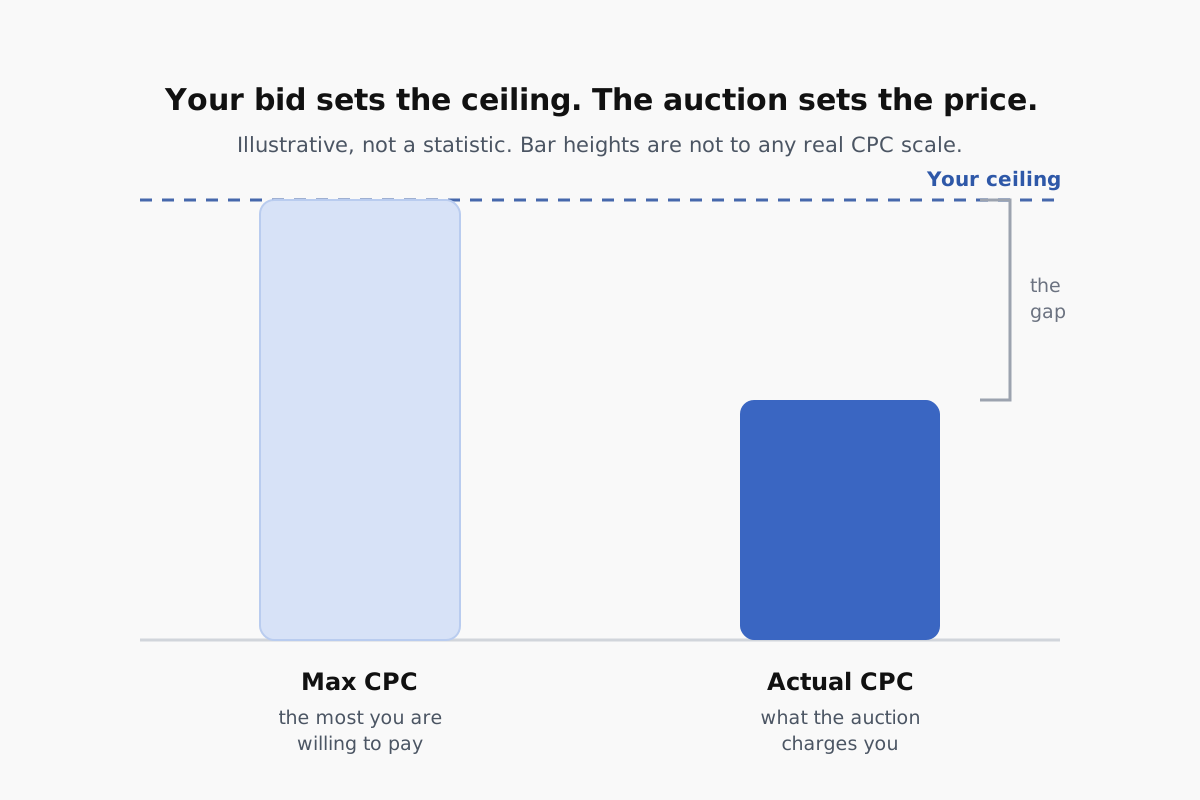
This is the thing most cost articles skip. The maximum cost-per-click you set is not what you pay. Google's documentation says your actual cost-per-click "is the final amount you're charged for a click" and that "you're often charged less — sometimes much less — than your maximum cost-per-click (max. CPC) bid." The reason is mechanical: "with the Google Ads auction, you only pay what's minimally required to clear the Ad Rank thresholds and beat the Ad Rank of the competitor immediately below you." Where there is no competitor immediately below you, Google says you pay only the reserve price.
Source: Google Ads Help, "Actual cost-per-click (CPC): Definition" (answer 6297).
What decides the number: Ad Rank
If the price is decided per auction, something has to decide it. That something is Ad Rank, which Google defines as "a set of values that are used to determine whether your ads are eligible to show and if eligible, where on the page your ads are shown."
Only one item on the input list is your bid. Google states Ad Rank is "calculated based on many factors, including your bid amount, the quality of your ads and landing page, the Ad Rank thresholds, the competitiveness of an auction, the context of the person's search (for example, the person's location, device, time of search, the nature of the search terms, the other ads and search results that show on the page, and other user signals and attributes), and the expected impact of assets and other ad formats."
Source: Google Ads Help, "Ad Rank: Definition" (answer 1752122).
Read that as a business owner. Location, device, time of day and the exact wording of the search are all inputs into what you pay. A plumbing search in Vashi at 11pm on a phone is not the same auction as one in Kharghar at 11am on a laptop, same keyword and same bid. Google adds that "your ad position can fluctuate each time depending on your competition, the context of the person's search, and your quality at that moment."
One counterintuitive detail, before you assume that winning is always cheaper: "as the gap in ad rank between two advertisers' ads grows, the higher-ranking ad will be more likely to win but also may pay a higher cost per click." Being far ahead of the field is not automatically the cheap position.
Source: Google Ads Help, "How the Google Ads auction works" (answer 6366577).
Why every CPC table online disagrees, ours included
Before writing this we read two of the pages currently ranking for "google ads cost in india" and compared their numbers against each other. They do not agree, and not by a little.
Take insurance. One ranking guide says "insurance tops the chart at Rs 500 to Rs 3,000 per click for high-intent terms." Another puts insurance at "₹310–460." Both are published as 2026 India benchmarks for the same category, and the top of one is more than six times the top of the other. The first also gives a national average, "Rs 5 to Rs 50 for most consumer-facing industries, and Rs 100 to Rs 600+ for high-intent verticals"; the second declines to give a national average at all.
Compared: upGrowth, "Google Ads Pricing India 2026" and Nico Digital, "Google Ads Cost in India: 2026 CPC Benchmarks by Industry", both read 14 Sep 2026. Cited as evidence that published benchmarks disagree, not as figures we endorse or reuse.
That is not necessarily dishonesty. It is what happens when you average an auction. Every one of these changes the answer completely:
- Industry. A salon keyword and a corporate-law keyword are not the same market.
- City. Mumbai, Navi Mumbai, Indore and Guwahati are not the same competition.
- Campaign type. A blended "Google Ads" average quietly mixes Search, Display, Performance Max and YouTube, which cost very differently.
- Match type and date range. Broad match on a head term and exact match on a long-tail buying term sit at opposite ends; seasonality moves both inside the same account.
Our 2026 India benchmark click costs
The same benchmark click costs that power our free budget calculator. They are ours, they are directional, and they are not an industry average.
| Industry | Google Search CPC | Typical conv. rate |
|---|---|---|
| Restaurants & cafes | ₹10–35 | 5% |
| Salon, beauty & wellness | ₹10–40 | 6% |
| E-commerce / D2C | ₹15–50 | 2% |
| Home services (repair, cleaning) | ₹20–60 | 6% |
| Healthcare (clinics & hospitals) | ₹25–70 | 5% |
| Hotels & resorts | ₹25–70 | 3% |
| Dental clinics | ₹30–80 | 5% |
| Education & coaching | ₹30–90 | 4% |
| Interior design & architecture | ₹30–90 | 3.5% |
| Real estate | ₹40–120 | 2.5% |
| CA & financial services | ₹40–120 | 4% |
| Insurance | ₹45–130 | 3.5% |
| Legal services | ₹50–150 | 5% |
| B2B & professional services | ₹60–150 | 3.5% |
Nex2Link's 2026 India benchmark click costs, compiled from published 2026 India benchmarks and our own campaign data. Your city and competition shift these. Media spend only, before GST and before any agency fee. Fourteen of thirty industries shown; the full table, with Meta click costs, is on the budget calculator.
How to read this table without fooling yourself
The two ends of a range are not "good" and "bad" — they are usually two different keywords. The bottom of the healthcare range is closer to a clinic name plus a locality; the top is closer to the generic head term every hospital in the city is also bidding on. Which half you live in is mostly decided by which keywords you buy.
The conversion-rate column matters as much as the CPC column and gets ignored far more often. A ₹30 click at a 5% landing page conversion rate costs ₹600 per enquiry. The same ₹30 click at 2% costs ₹1,500. Your website, not your bid, caused that difference.
Want this as a number for your industry, your lead target and your budget? That is what the calculator does.
Run the budget calculator →How your monthly budget is actually spent
"What is the minimum budget for Google Ads in India" has a cleaner answer than the CPC question, because Google documents the mechanics precisely. You do not set a monthly budget. You set an average daily budget, "the average amount that you set for each ad campaign on a per-day basis." Google spends against it unevenly on purpose — more on days it sees opportunity, less on quiet days — inside two published caps:
- On any single day, Google will not charge more than twice your average daily budget for most campaigns.
- In any month, you will not be charged more than 30.4 times your average daily budget for most campaigns — 30.4 being the average days in a month, 365 divided by 12.
Source: Google Ads Help, "About average daily budgets" (answer 6385083).
So a ₹30,400 monthly ceiling means a ₹1,000 daily budget, and a day charged at ₹1,700 is not an overcharge, it is documented behaviour.
What Google does not say
On the Google help pages we checked, Google publishes no minimum monthly spend, for India or anywhere, so be careful with any page that states one as a Google rule. The real floor is arithmetic: divide your budget by the middle of your industry's click cost for roughly how many clicks it buys, then multiply by the conversion rate. If the answer is a handful of enquiries a month, the budget is too small to learn from.
Our own budget calculator page puts that floor at roughly ₹10,000 a month, below which campaigns rarely gather enough data to optimise properly. That is our guidance from our campaign experience, not a Google rule. To work the other way round — from a budget you already have to the lead volume it should produce — use the ad budget leads calculator.
What genuinely moves your cost down
Here is where most cost articles go wrong. They tell you to raise your Quality Score to lower your CPC. Google's documentation says something more specific, and the difference matters.
Google states plainly: "Quality Score is not an input in the ad auction. It's a diagnostic tool to identify how ads that show for certain keywords affect the user experience." It is "a diagnostic tool meant to give you a sense of how well your ad quality compares to other advertisers," reported 1 to 10 at the keyword level.
Source: Google Ads Help, "About Quality Score for Search campaigns" (answer 6167118).
What the auction does use is auction-time ad quality: expected clickthrough rate, ad relevance and landing page experience, which appear in the Ad Rank factors above. Quality Score is the readout of those same three components. So the instruction is not "improve your Quality Score". It is: improve the three things underneath it, then use Quality Score to check whether it worked.
Expected clickthrough rate
Google's definition: "the likelihood that your ad will be clicked when shown." A relevance problem, not a cleverness problem. Ads written for one tight keyword group beat one generic ad stretched across fifty.
Ad relevance
Google's definition: "how closely your ad matches the intent behind a user's search." If someone searches a specific service in a specific area and your ad names neither, this is what you are losing on.
Landing page experience
Google's definition: "how relevant and useful your landing page is to people who click your ad." Sending every ad to your homepage is the most common, most expensive way to get this wrong.
Component definitions quoted from Google Ads Help, "About Quality Score for Search campaigns" (answer 6167118).
The levers nobody sells you
- Buy narrower keywords. The top of every range in our table is the generic head term. Long-tail and locality-specific searches are usually cheaper per click and better converting.
- Fix the landing page before raising the budget. It is one of the three documented quality components and it sets your conversion rate, so it moves your cost per enquiry twice.
- Tighten location targeting. Location is a documented Ad Rank input via the context of the search. Paying for clicks from cities you cannot serve is the most avoidable waste in a local account.
- Use negative keywords early. Every irrelevant search you stop paying for lowers your blended cost per enquiry without touching a bid.
None of these are exotic. They are just slower to sell than "we'll lower your CPC".
Ad spend, agency fees and GST are three different things
Much of the confusion about what Google Ads costs in India is not about CPC at all. It is that three separate numbers get quoted as one.
1. Ad spend is the money that goes to Google to buy clicks. Every CPC benchmark here and elsewhere means this. You control it with your average daily budget.
2. The agency or freelancer fee pays a person or team to plan, build, run and report on the campaigns. Separate invoice, separate entity, buys labour rather than clicks. Those ranges live in our separate guide to how much digital marketing costs in India. If a proposal gives you one monthly figure, ask which of the two it covers before comparing it with anyone else's.
3. GST. Google's payments centre help states the Integrated GST rate is 18%, with Central GST at 9% and State GST at 9%, and that "you are charged CGST (9%) + SGST (9%) when your 'Bill to' address state matches the state of the 'Bill from' location. Otherwise, IGST (18%) is charged for all other 'Bill to' states." Special Economic Zone customers are charged GST of 0%. Google asks business accounts to add their GSTIN in payments profile settings so the correct tax is applied.
Source: Google payments centre help, "GST (Goods and Services Tax) on purchases".
Google Ads cost in India: frequently asked questions
How much does Google Ads cost in India?
There is no single price, because the cost is set per click by an auction that runs on every search. You choose the budget; the auction sets the click price. Our own 2026 India benchmark click costs run from roughly ₹10 per click for restaurants and salons to ₹150 for legal and B2B, before GST. Treat that as a planning range, not a quote.
What is the minimum budget for Google Ads in India?
Google publishes no minimum spend on any of its help pages we checked. The practical floor is your own arithmetic: the budget has to buy enough clicks at your industry's click cost to produce enough enquiries to learn from. Our budget calculator page puts that at roughly ₹10,000 a month, below which campaigns rarely gather enough data to optimise.
What is the Google Ads cost per click in India?
It changes per auction, per keyword, per city and per moment. Google states you "only pay what's minimally required to clear the Ad Rank thresholds and beat the Ad Rank of the competitor immediately below you". That is why two advertisers with the same maximum bid on the same keyword can pay different amounts. Our published 2026 India benchmark Google Search click costs run from about ₹10 to ₹150 by industry.
Does Google charge my maximum CPC bid on every click?
No. Google's documentation says you're "often charged less — sometimes much less — than your maximum cost-per-click (max. CPC) bid". Your max CPC is a ceiling you are willing to pay, not the price you pay.
Does a higher Quality Score lower my Google Ads cost in India?
Not directly, and this is widely reported wrongly. Google states that "Quality Score is not an input in the ad auction" and is "a diagnostic tool". The auction uses auction-time ad quality — expected clickthrough rate, ad relevance and landing page experience. Improve those three; Quality Score is how you check whether it worked.
Is GST charged on Google Ads spend in India?
Yes. Google's payments centre help states the Integrated GST rate is 18%, made up of Central GST at 9% and State GST at 9%, charged as CGST plus SGST when your bill-to state matches the bill-from state and as IGST of 18% otherwise. Special Economic Zone customers are charged 0%. Every click-cost benchmark you read, ours included, is media spend before tax.
Is Google Ads spend the same as an agency's fee?
No, and they are billed separately. Ad spend goes to Google to buy clicks. An agency fee pays a person or team to plan, build, run and report on the campaigns. Any quoted monthly number should say which of the two it covers, and whether GST is included. Agency-fee ranges are in our separate guide to digital marketing cost in India.
The useful version of the question
"How much does Google Ads cost in India" cannot be answered honestly by anyone who has not seen your account. "What would an enquiry cost me, at my industry's click costs, with my conversion rate, in my city" can be estimated in about a minute, and that is the number you need before you spend anything.
Do that estimate first. If the cost per enquiry it produces sits comfortably below what a customer is worth to you, Google Ads is worth testing. If it does not, no amount of bid tinkering rescues the arithmetic, and it is better to find that out on a calculator than three months into a budget.
Get a number for your business
Our free budget calculator uses these benchmark click costs and conversion rates to turn your industry and monthly lead target into a realistic rupee range. No email, no sign-up.
Open the budget calculator →